


OneStep ELISA Kit for Myoglobin (MYO) 

PVALB; MB
Overview
Properties
- Product No.OEA480Hu
- Organism SpeciesHomo sapiens (Human) Same name, Different species.
- ApplicationsEnzyme-linked immunosorbent assay for Antigen Detection.
Research use only - Downloadn/a
- CategoryCardiovascular biology
Sign into your account
Share a new citation as an author
Upload your experimental result
Review

Contact us
Please fill in the blank.
-
 Packages (Simulation)
-
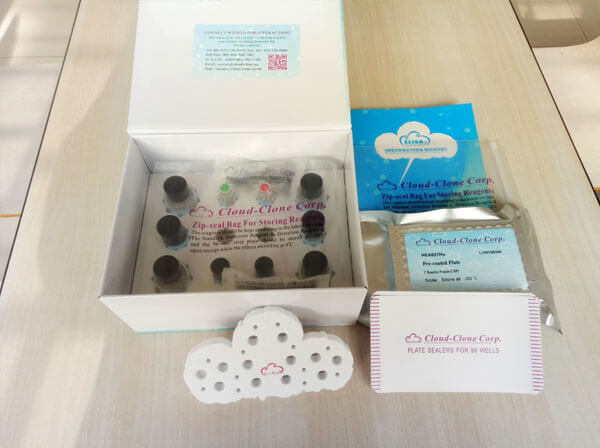 Packages (Simulation)
-
 ISO9001: 2008, ISO13485: 2003 Registered
Recovery
Matrices listed below were spiked with certain level of recombinant Myoglobin (MYO) and the recovery rates were calculated by comparing the measured value to the expected amount of Myoglobin (MYO) in samples.
| Matrix | Recovery range (%) | Average(%) |
| serum(n=5) | 91-98 | 95 |
| EDTA plasma(n=5) | 79-91 | 84 |
| heparin plasma(n=5) | 80-103 | 90 |
Precision
Intra-assay Precision (Precision within an assay): 3 samples with low, middle and high level Myoglobin (MYO) were tested 20 times on one plate, respectively.
Inter-assay Precision (Precision between assays): 3 samples with low, middle and high level Myoglobin (MYO) were tested on 3 different plates, 8 replicates in each plate.
CV(%) = SD/meanX100
Intra-Assay: CV<10%
Inter-Assay: CV<12%
Linearity
The linearity of the kit was assayed by testing samples spiked with appropriate concentration of Myoglobin (MYO) and their serial dilutions. The results were demonstrated by the percentage of calculated concentration to the expected.
| Sample | 1:2 | 1:4 | 1:8 | 1:16 |
| serum(n=5) | 88-96% | 79-101% | 81-99% | 98-105% |
| EDTA plasma(n=5) | 78-103% | 98-105% | 81-98% | 98-105% |
| heparin plasma(n=5) | 84-93% | 88-103% | 97-105% | 81-96% |
Stability
The stability of kit is determined by the loss rate of activity. The loss rate of this kit is less than 5% within the expiration date under appropriate storage condition.
To minimize extra influence on the performance, operation procedures and lab conditions, especially room temperature, air humidity, incubator temperature should be strictly controlled. It is also strongly suggested that the whole assay is performed by the same operator from the beginning to the end.
Reagents and materials provided
| Reagents | Quantity | Reagents | Quantity |
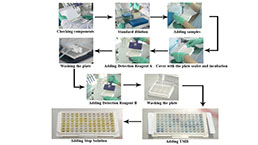
Assay procedure summary
1. Prepare all reagents, samples and standards;
2. Add 50µL standard or sample to each well, then add 50µL prepared Detection Reagent A to each well. Incubate 1 hour at 37°C;
3. Aspirate and wash 3 times;
4. Add 90µL Substrate Solution. Incubate 10-20 minutes at 37°C;
5. Add 50µL Stop Solution. Read at 450nm immediately.

Test principle
The test principle applied in this kit is Sandwich enzyme immunoassay. The microplate provided in this kit has been pre-coated with an antibody specific to Myoglobin (MYO). Standards or samples are then added to the appropriate microplate wells with a HRP-conjugated antibody specific to Myoglobin (MYO). After TMB substrate solution is added, only those wells that contain Myoglobin (MYO) and HRP-conjugated antibody will exhibit a change in color. The enzyme-substrate reaction is terminated by the addition of sulphuric acid solution and the color change is measured spectrophotometrically at a wavelength of 450nm ± 10nm. The concentration of Myoglobin (MYO) in the samples is then determined by comparing the O.D. of the samples to the standard curve.
Giveaways
Increment services



Citations
- Acute leukocyte, cytokine and adipocytokine responses to maximal and hypertrophic resistance exercise boutsPubmed:25145982
- Transcriptional Alterations by Ischaemic Postconditioning in a Pig Infarction Model: Impact on Microvascular ProtectionPubmed: 30650650
- Electrochemical dual-aptamer-based biosensor for nonenzymatic detection of cardiac troponin I by nanohybrid electrocatalysts labeling combined with DNA …Pubmed: 30954926
- DNA nanotetrahedron linked dual-aptamer based voltammetric aptasensor for cardiac troponin I using a magnetic metal-organic framework as a labelPubmed: 31123904
- Emitter–Quencher Pair of Single Atomic Co Sites and Monolayer Titanium Carbide MXenes for Luminol Chemiluminescent Reactions34914377
- A rapid fluorescent aptasensor for point-of-care detection of C-reactive proteinPubmed:35714415