


Active Glia Derived Nexin (GDN) 

SERPINE2; PI7; PN1; PNI; Protease Nexin I; Serpin Peptidase Inhibitor Clade E Member 2; Peptidase inhibitor 7; Protease nexin I
- UOM
- FOB US$ 254.00 US$ 636.00 US$ 1,272.00 US$ 3,816.00 US$ 9,540.00
- Quantity
Overview
Properties
- Product No.APD381Hu01
- Organism SpeciesHomo sapiens (Human) Same name, Different species.
- ApplicationsCell culture; Activity Assays.
Research use only - DownloadInstruction Manual
- CategoryNeuro science
- Buffer FormulationPBS, pH7.4, containing 0.01% SKL, 5% Trehalose.
- Traits Freeze-dried powder, Purity > 95%
- Isoelectric Point9.4
Sign into your account
Share a new citation as an author
Upload your experimental result
Review

Contact us
Please fill in the blank.
-
 Packages (Simulation)
-
 Packages (Simulation)
-
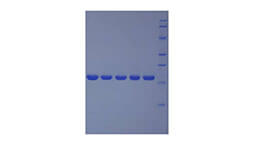
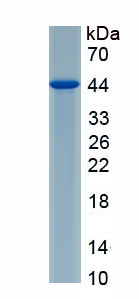 Figure. SDS-PAGE
-
 ISO9001: 2008, ISO13485: 2003 Registered
Activity test
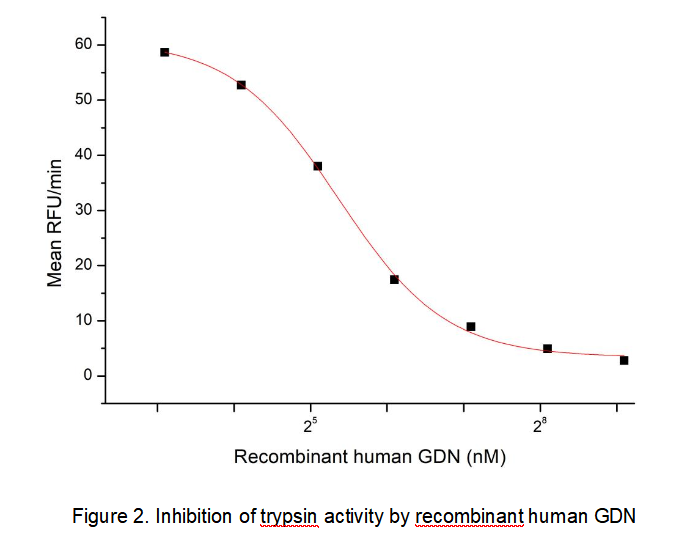
Glia-Derived Nexin (GDN), also known as protease nexin-1 (PN-1), is a serine protease inhibitor secreted by glial cells. It belongs to the serpin superfamily and plays a crucial role in regulating extracellular proteolysis, particularly by inhibiting thrombin and plasminogen activators. GDN is involved in neurite outgrowth, synaptic plasticity, and tissue repair, making it important in nervous system development and neuroprotection. Studies suggest its role in preventing excessive proteolytic activity that could damage neural networks. The activity of recombinant human GDN was measured by its ability to inhibit trypsin cleavage of a fluorogenic peptide substrate Mca-RPKPVE-Nval-WRK(Dnp)-NH2 in the assay buffer 50 mM Tris, 10 mM CaCl2, 150 mM NaCl, 0.05% (w/v) Brij-35, pH 7.5. Trypsin was diluted to 50 ug/ml in the assay buffer and 25 ul different concentrations of recombinant human GDN (MW: 45.7 KD) was incubated with 25 ul diluted trypsin at 37 ℃ for 30 minutes. Loading 50 µL of the incubated mixtures which were diluted five-fold in assay buffer into empty wells of a plate, and start the reaction by adding 50 µL of 20 µM substrate. Include a substrate blank containing 50 µL of assay buffer and 50 µL of 20 µM substrate. Then read at excitiation and emission wavelengths of 320 nm and 405 nm, respectively, in kinetic mode for 5 minutes. The result was shown in Figure 1 and it was obvious that recombinant human GDN significantly decreased trypsin activity. The inhibition IC50 was <42 nM.
Usage
Reconstitute in 10mM PBS (pH7.4) to a concentration of 0.1-1.0 mg/mL. Do not vortex.
Storage
Avoid repeated freeze/thaw cycles. Store at 2-8°C for one month. Aliquot and store at -80°C for 12 months.
Stability
The thermal stability is described by the loss rate. The loss rate was determined by accelerated thermal degradation test, that is, incubate the protein at 37°C for 48h, and no obvious degradation and precipitation were observed. The loss rate is less than 5% within the expiration date under appropriate storage condition.
Increment services
-
 BCA Protein Quantification Kit
-
 Molecular Mass Marker for Protein
-
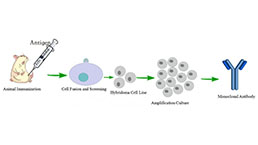 Monoclonal Antibody Customized Service
-
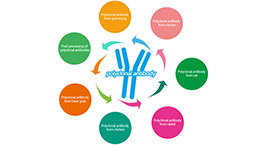 Polyclonal Antibody Customized Service
-
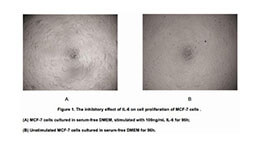 Protein Activity Test Experiment Service
-
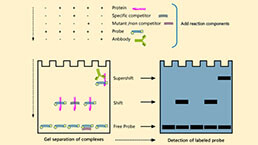 Electrophoretic Mobility Shift Assay (EMSA) Experiment Service
-
 Buffer
-
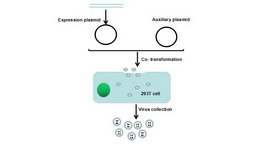 Lentivirus Packaging Experiment Service
-
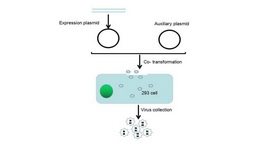 Adenovirus Packaging Experiment Service
-
 Real Time PCR Experimental Service
-
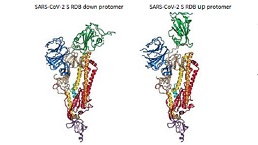 Spike RBD Protein (S-RBD)
-
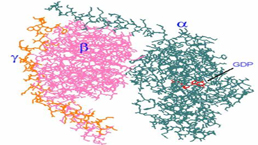 Protein G
-
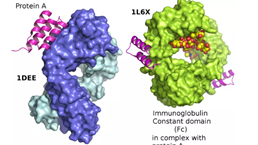 Protein A
Citations
- Clinical Biomarkers for the Noninvasive Diagnosis of Endometriosishandle:11375
- The Involvement of Protease Nexin-1 (PN1) in the Pathogenesis of Intervertebral Disc (IVD) Degenerationpubmed:27460424