


Active Heat Shock 70kDa Protein 9 (HSPA9) 

CSA; GRP75; HSPA9B; MOT; MOT2; MTHSP75; PBP74; Mot-2; Stress-70 Protein,Mitochondrial; Mortalin,Perinuclear; 75 kDa glucose-regulated protein; Peptide-binding protein 74
- UOM
- FOB US$ 252.00 US$ 630.00 US$ 1,260.00 US$ 3,780.00 US$ 9,450.00
- Quantity
Overview
Properties
- Product No.APB082Hu01
- Organism SpeciesHomo sapiens (Human) Same name, Different species.
- ApplicationsCell culture; Activity Assays.
Research use only - DownloadInstruction Manual
- CategorySignal transduction
- Buffer FormulationPBS, pH7.4, containing 0.01% SKL, 5% Trehalose.
- Traits Freeze-dried powder, Purity > 95%
- Isoelectric Point7.9
Sign into your account
Share a new citation as an author
Upload your experimental result
Review

Contact us
Please fill in the blank.
-
 Packages (Simulation)
-
 Packages (Simulation)
-
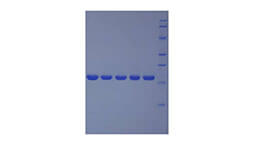
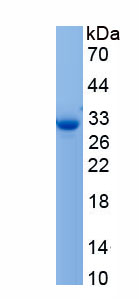 Figure. SDS-PAGE
-
 ISO9001: 2008, ISO13485: 2003 Registered
Activity test
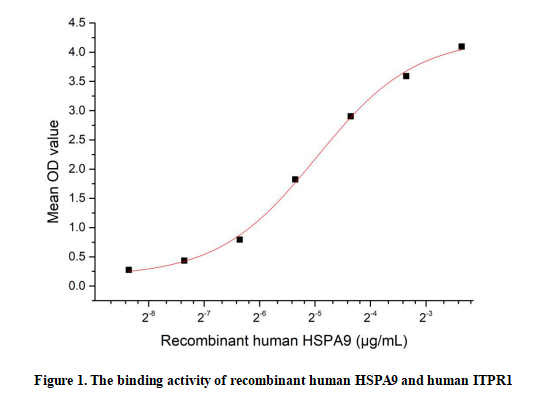
Heat Shock 70kDa Protein 9 (HSPA9), also termed mortalin, belongs to the conserved Hsp70 chaperone family and predominantly localizes in mitochondria. It mediates mitochondrial protein import, facilitates proper folding of newly synthesized polypeptides, and eliminates misfolded or aggregated proteins to maintain mitochondrial proteostasis. Beyond chaperone functions, HSPA9 participates in regulating cellular metabolism, oxidative stress response, cell proliferation and apoptosis. Dysregulated HSPA9 expression is closely linked to tumour progression, neurodegenerative disorders and mitochondrial dysfunction-related diseases. It stabilizes mitochondrial membrane integrity and balances reactive oxygen species levels, acting as a vital guardian of mitochondrial homeostasis under physiological and stress conditions. HSPA9 directly interacts with ITPR1 to modulate endoplasmic reticulum-mitochondria calcium transfer. Thus a functional ELISA assay was conducted to detect the interaction of recombinant human HSPA9 and recombinant human ITPR1. Briefly, HSPA9 was diluted serially in PBS with 0.01% BSA (pH 7.4). Duplicate samples of 100 μL were then transferred to ITPR1-coated microtiter wells and incubated for 1h at 37℃. Wells were washed with PBST and incubated for 1h with anti-HSPA9 pAb, then aspirated and washed 3 times. After incubation with HRP labelled secondary antibody for 1h at 37℃, wells were aspirated and washed 5 times. With the addition of substrate solution, wells were incubated 15-25 minutes at 37℃. Finally, add 50 µL stop solution to the wells and read at 450/630nm immediately. The binding activity of recombinant human HSPA9 and recombinant human ITPR1 was shown in Figure 1, the EC50 for this effect is 1.06326µg/mL.
Usage
Reconstitute in 10mM PBS (pH7.4) to a concentration of 0.1-1.0 mg/mL. Do not vortex.
Storage
Avoid repeated freeze/thaw cycles. Store at 2-8°C for one month. Aliquot and store at -80°C for 12 months.
Stability
The thermal stability is described by the loss rate. The loss rate was determined by accelerated thermal degradation test, that is, incubate the protein at 37°C for 48h, and no obvious degradation and precipitation were observed. The loss rate is less than 5% within the expiration date under appropriate storage condition.
Increment services
-
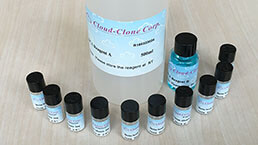 BCA Protein Quantification Kit
-
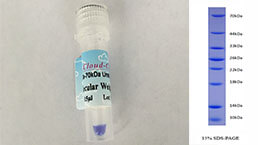 Molecular Mass Marker for Protein
-
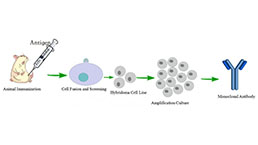 Monoclonal Antibody Customized Service
-
 Polyclonal Antibody Customized Service
-
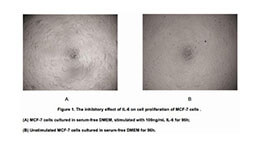 Protein Activity Test Experiment Service
-
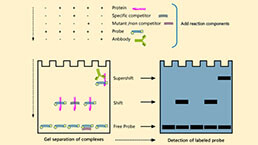 Electrophoretic Mobility Shift Assay (EMSA) Experiment Service
-
 Buffer
-
 Lentivirus Packaging Experiment Service
-
 Adenovirus Packaging Experiment Service
-
 Real Time PCR Experimental Service
-
 Spike RBD Protein (S-RBD)
-
 Protein G
-
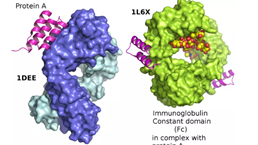 Protein A
Citations
- Bufalin Induced Mitochondrial Dysfunction Promotes Apoptosis of Glioma Cells by Regulating Annexin A2 and DRP1 Proteins
- Bufalin induces mitochondrial dysfunction and promotes apoptosis of glioma cells by regulating Annexin A2 and DRP1 protein expression34376212