


Active Matrix Metalloproteinase 7 (MMP7) 

MPSL1; MAT; PUMP-1; Matrilysin Uterine; Matrilysin; Matrin; Pump-1 Protease; Uterine Metalloproteinase
- UOM
- FOB US$ 260.00 US$ 650.00 US$ 1,300.00 US$ 3,900.00 US$ 9,750.00
- Quantity
Overview
Properties
- Product No.APA102Hu02
- Organism SpeciesHomo sapiens (Human) Same name, Different species.
- ApplicationsCell culture; Activity Assays.
Research use only - DownloadInstruction Manual
- CategoryEnzyme & KinaseTumor immunity
- Buffer FormulationPBS, pH7.4, containing 0.01% SKL, 5% Trehalose.
- Traits Freeze-dried powder, Purity > 90%
- Isoelectric Point7.8
Sign into your account
Share a new citation as an author
Upload your experimental result
Review

Contact us
Please fill in the blank.
-
 Packages (Simulation)
-
 Packages (Simulation)
-
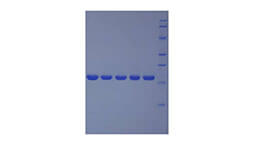
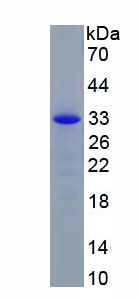 Figure. SDS-PAGE
-
 ISO9001: 2008, ISO13485: 2003 Registered
Activity test
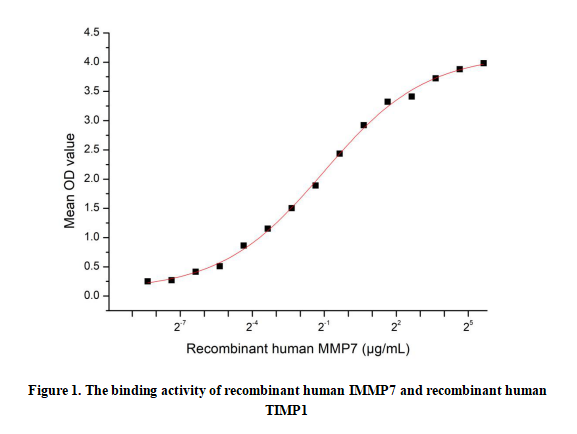
Matrix Metalloproteinase 7 (MMP7), also known as matrilysin, is a small secreted protease belonging to the MMP family. It plays key roles in extracellular matrix degradation, tissue remodeling, wound healing, and cancer progression by cleaving substrates like collagen, fibronectin, and proteoglycans. Unlike other MMPs, MMP7 lacks a hemopexin domain but remains highly active in processing cytokines and growth factors. It is overexpressed in various cancers and inflammatory diseases. MMP7 activity is tightly regulated by Tissue Inhibitor of Metalloproteinases 1 (TIMP1), which binds to MMP7 in a 1:1 stoichiometry to inhibit its proteolytic function.To detect the activity of recombinant MMP7, a functional ELISA assay was performed to evaluate the interaction between recombinant human IMMP7 and recombinant human TIMP1.Briefly, MMP7 was diluted serially in PBS with 0.01% BSA (pH 7.4). Duplicate samples of 100 μl were then transferred to TIMP1-coated microtiter wells and incubated for 1h at 37℃. Wells were washed with PBST and incubated for 1h with anti-MMP7 pAb, then aspirated and washed 3 times. After incubation with HRP labelled secondary antibody for 1h at 37℃, wells were aspirated and washed 5 times. With the addition of substrate solution, wells were incubated 15-25 minutes at 37℃. Finally, add 50 µL stop solution to the wells and read at 450/630nm immediately. The binding activity of recombinant human IMMP7 and recombinant human TIMP1 was shown in Figure 1, the EC50 for this effect is 0.49 µg/mL..
Usage
Reconstitute in 10mM PBS (pH7.4) to a concentration of 0.1-1.0 mg/mL. Do not vortex.
Storage
Avoid repeated freeze/thaw cycles. Store at 2-8°C for one month. Aliquot and store at -80°C for 12 months.
Stability
The thermal stability is described by the loss rate. The loss rate was determined by accelerated thermal degradation test, that is, incubate the protein at 37°C for 48h, and no obvious degradation and precipitation were observed. The loss rate is less than 5% within the expiration date under appropriate storage condition.
Increment services
-
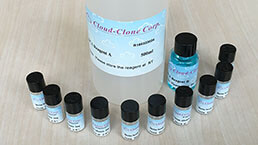 BCA Protein Quantification Kit
-
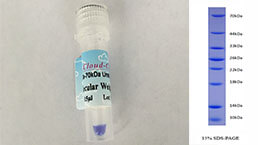 Molecular Mass Marker for Protein
-
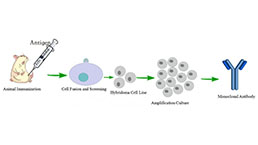 Monoclonal Antibody Customized Service
-
 Polyclonal Antibody Customized Service
-
 Protein Activity Test Experiment Service
-
 Electrophoretic Mobility Shift Assay (EMSA) Experiment Service
-
 Buffer
-
 Lentivirus Packaging Experiment Service
-
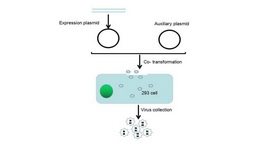 Adenovirus Packaging Experiment Service
-
 Real Time PCR Experimental Service
-
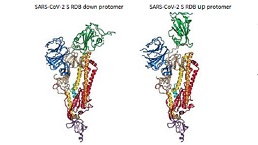 Spike RBD Protein (S-RBD)
-
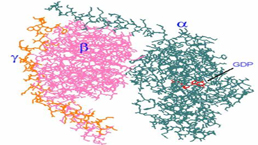 Protein G
-
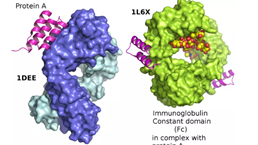 Protein A
Citations
- A novel, orally active LPA1 receptor antagonist inhibits lung fibrosis in the mouse bleomycin modelPubMed: 20649573
- Upregulated Expression of Matrix Metalloproteinases and Tissue Inhibitors of Matrix Metalloproteinases in BALB/c Mouse Brain Challenged with Japanese Encephalitis VirusPubmed: source
- A Combinatorial Relative Mass Value Evaluation of Endogenous Bioactive Proteins in Three-Dimensional Cultured Nucleus Pulposus Cells of Herniated Intervertebral Discs: Identification of Potential Target Proteins for Gene Therapeutic ApproachesPlosone: Source
- Analysis of the expression of nine secreted matrix metalloproteinases and their endogenous inhibitors in the brain of mice subjected to ischaemic strokePubmed:24671655
- Estrogen-deficient osteoporosis enhances the recruitment and activity of osteoclasts by breast cancer cellsPubMed: 26254457
- Circulating levels of matrix metalloproteinases and tissue inhibitors of matrix metalloproteinases during Japanese encephalitis virus infectionPubmed:26925446
- Systematic phenotyping and correlation of biomarkers with lung function and histology in lung fibrosisPubmed:26993522
- The MiR-495/Annexin A3/P53 Axis Inhibits the Invasion and EMT of Colorectal Cancer Cellspubmed:29224019
- Thyroid disrupting effects and associated mechanisms of TCPP in GH3 cell line and zebrafish (Danio rerio) larva and adult10371/137708
- Large-scale proteomics identifies MMP-7 as a sentinel of epithelial injury and of biliary atresia.pubmed:29167395
- Diagnostic Accuracy of Serum Matrix Metalloproteinase‐7 for Biliary AtresiaPubmed: 30153340
- Quantification of Serum Matrix Metallopeptide 7 Levels May Assist in the Diagnosis and Predict the Outcome for Patients with Biliary AtresiaPubmed: 30853207
- Serum MMP-7 in the Diagnosis of Biliary AtresiaPubmed: 31604829
- Human umbilical cord blood mononuclear cells protect against renal tubulointerstitial fibrosis in cisplatin-treated ratsPubmed: 31710895
- The synthetic toxin biliatresone causes biliary atresia in micePubmed: 32681026
- Interstitial Score and Concentrations of IL-4R¦Á, PAR-2, and MMP-7 in Bronchoalveolar Lavage Fluid Could Be Useful Markers for Distinguishing Idiopathic Interstitial?¡33924683
- A novel strategy to identify candidate diagnostic and prognostic biomarkers for gastric cancer34215253