


Active Retinol Binding Protein 4 (RBP4) 

PRBP; RBP; Plasma retinol-binding protein; Retinol Binding Protein 4, Plasma
- UOM
- FOB US$ 218.00 US$ 545.00 US$ 1,090.00 US$ 3,270.00 US$ 8,175.00
- Quantity
Overview
Properties
- Product No.APA929Hu62
- Organism SpeciesHomo sapiens (Human) Same name, Different species.
- ApplicationsCell culture; Activity Assays.
Research use only - Downloadn/a
- CategoryMetabolic pathwayEndocrinologyHormone metabolism
- Buffer FormulationPBS, pH7.4, containing 5% Trehalose.
- Traits Freeze-dried powder, Purity > 90%
- Isoelectric Point5.4
Sign into your account
Share a new citation as an author
Upload your experimental result
Review

Contact us
Please fill in the blank.
-
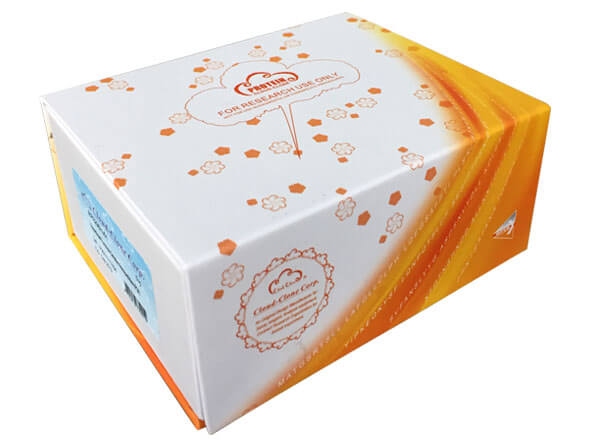 Packages (Simulation)
-
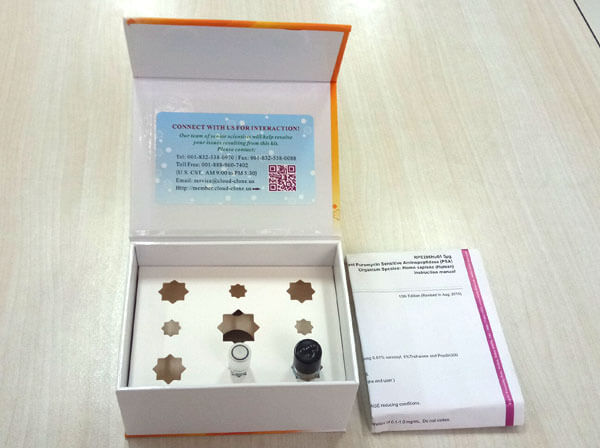 Packages (Simulation)
-
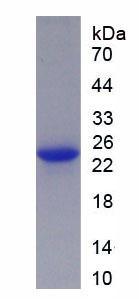 SDS-PAGE
-
 ISO9001: 2008, ISO13485: 2003 Registered
Activity test
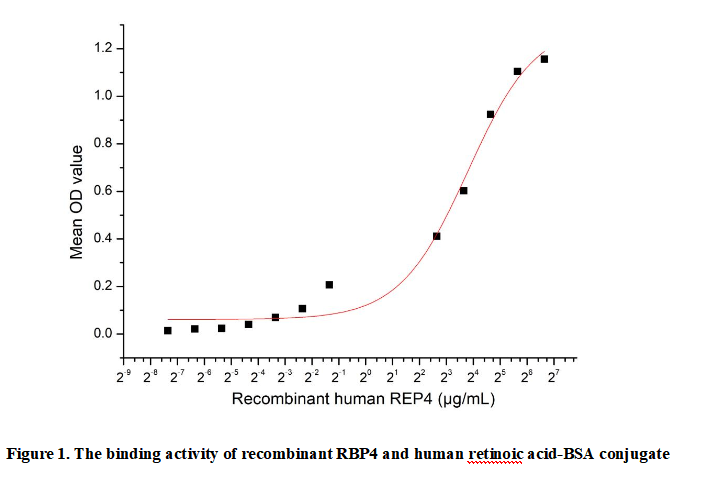
Retinol Binding Protein 4 (RBP4) is a 21-kDa secreted glycoprotein belonging to the lipocalin family, predominantly synthesized in the liver and adipose tissue. It functions as the primary carrier of retinol (vitamin A) in the bloodstream, facilitating retinol transport to target tissues and regulating systemic vitamin A homeostasis. RBP4 plays critical roles in vision, epithelial cell differentiation, immune function, and metabolic regulation, with dysregulation linked to obesity, type 2 diabetes, and cardiovascular diseases. RBP4 binds to retinoic acid-BSA conjugate, enabling targeted delivery of retinoic acid and enhancing its bioavailability in biological systems.Thus a functional ELISA assay was conducted to detect the interaction of recombinant human RBP4 and recombinant human retinoic acid-BSA conjugate. Briefly, RBP4 was diluted serially in PBS with 0.01% BSA (pH 7.4). Duplicate samples of 100 μl were then transferred to retinoic acid-BSA conjugate-coated microtiter wells and incubated for 1h at 37℃. Wells were washed with PBST and incubated for 1h with anti-RBP4 pAb, then aspirated and washed 3 times. After incubation with HRP labelled secondary antibody for 1h at 37℃, wells were aspirated and washed 5 times. With the addition of substrate solution, wells were incubated 15-25 minutes at 37℃. Finally, add 50 µL stop solution to the wells and read at 450/630nm immediately. The binding activity of recombinant rat RBP4 and recombinant human retinoic acid-BSA conjugate was shown in Figure 1, the EC50 for this effect is 13.88µg/mL.
Usage
Reconstitute in 10mM PBS (pH7.4) to a concentration of 0.1-1.10 mg/mL. Do not vortex.
Storage
Avoid repeated freeze/thaw cycles. Store at 2-8°C for one month. Aliquot and store at -80°C for 12 months.
Stability
The thermal stability is described by the loss rate. The loss rate was determined by accelerated thermal degradation test, that is, incubate the protein at 37°C for 48h, and no obvious degradation and precipitation were observed. The loss rate is less than 5% within the expiration date under appropriate storage condition.
Increment services
-
 BCA Protein Quantification Kit
-
 Molecular Mass Marker for Protein
-
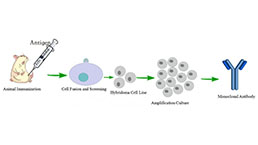 Monoclonal Antibody Customized Service
-
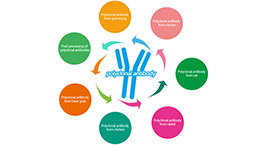 Polyclonal Antibody Customized Service
-
 Protein Activity Test Experiment Service
-
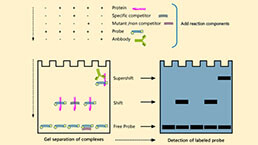 Electrophoretic Mobility Shift Assay (EMSA) Experiment Service
-
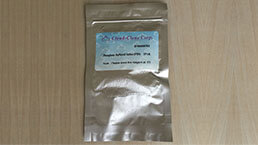 Buffer
-
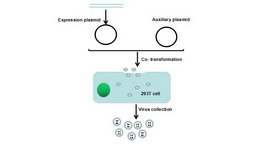 Lentivirus Packaging Experiment Service
-
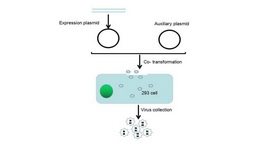 Adenovirus Packaging Experiment Service
-
 Real Time PCR Experimental Service
-
 Spike RBD Protein (S-RBD)
-
 Protein G
-
 Protein A
Citations
- Proteomic Identification of Human Urinary Biomarkers in Diabetes Mellitus Type 2 Liebert: 20100078
- Effect of high dose thiamine on the levels of urinary protein biomarkers in diabetes mellitus type 2PubMed: 21130593
- Quercetin Protects against Cadmium-Induced Renal Uric Acid Transport System Alteration and Lipid Metabolism Disorder in RatsPubMed: PMC3368504
- Combined galanin with insulin improves insulin sensitivity of diabetic rat musclesPubmed:24501381
- Central alarin ameliorated insulin resistance of adipocytes in type 2 diabetic ratsPubmed:25240061
- Effect of endogenous galanin on glucose transporter 4 expression in cardiac muscle of type 2 diabetic ratsPubmed:25445608
- Long-term Effect of Ileal Transposition on Adipokine Serum Level in Zucker (Orl)-Lepr fa Fatty RatsPubmed:25697126
- Differentially expressed urinary biomarkers in children with idiopathic nephrotic syndromePubMed: 26351173
- Expression of retinol binding protein 4 and nuclear factor-ÎşB in diabetic rats with atherosclerosis and the intervention effect of pioglitazonePubmed:27446311
- Expression of retinol binding protein 4 and nuclear factor-κB in diabetic rats with atherosclerosisand the intervention effect of pioglitazone.pubmed:27446311
- Application of a new procedure for liquid chromatography/mass spectrometry profiling of plasma amino acid-related metabolites and untargeted shotgun proteomics to identify mechanisms and biomarkers of calcific aortic stenosisS0021967317311858
- Screening for immune-potentiating antigens from hepatocellular carcinoma patients after radiofrequency ablation by serum proteomic analysisPubmed:29386009
- Lack of pronounced changes in the expression of fatty acid handling proteins in adipose tissue and plasma of morbidly obese humansPubmed:29335416
- RBP4 regulates trophoblastic cell proliferation and invasion via the PI3K/AKT signaling pathwayPubmed:30015949
- Relationship between retinol and risk of diabetic retinopathy: a case-control study
- Retinol binding protein 4 abundance in plasma and tissues is related to body fat deposition in cattlePubmed: 31147589
- Potassium supplementation blunts the effects of high salt intake on serum retinol‐binding protein 4 levels in healthy individuals
- Docosahexaenoic acid (DHA), a nutritional supplement, modulates steroid insensitivity in asthma
- The dietary inflammatory index is associated with anti-and pro-inflammatory adipokines in Brazilian schoolchildren33575861
- Pro-and anti-inflammatory adipokines are associated with cardiometabolic risk markers in Brazilian schoolchildren33834274
- Ileal transposition helps to regulate plasma hepatokine levels in obese Zucker (Crl: ZUC (ORL)-Lepr fa) rats33833309
- Biomarkers of cadmium exposure and renal function in estuarine adult villagers34773507