


Active S100 Calcium Binding Protein (S100) 

S100-A1; S100A1; S100-Alpha; S-100 Protein; S-100 protein subunit alpha; S-100 protein alpha chain
- UOM
- FOB US$ 288.00 US$ 720.00 US$ 1,440.00 US$ 4,320.00 US$ 10,800.00
- Quantity
Overview
Properties
- Product No.APA012Hu61
- Organism SpeciesHomo sapiens (Human) Same name, Different species.
- ApplicationsCell culture; Activity Assays.
Research use only - DownloadInstruction Manual
- CategoryTumor immunity
- Buffer FormulationPBS, pH7.4, containing 5% Trehalose.
- Traits Freeze-dried powder, Purity > 95%
- Isoelectric Point4.1
Sign into your account
Share a new citation as an author
Upload your experimental result
Review

Contact us
Please fill in the blank.
-
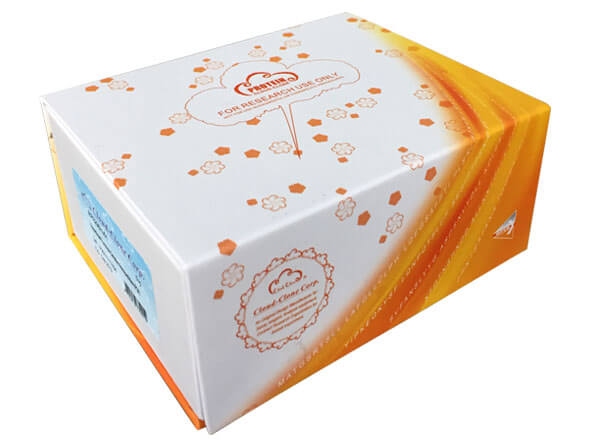 Packages (Simulation)
-
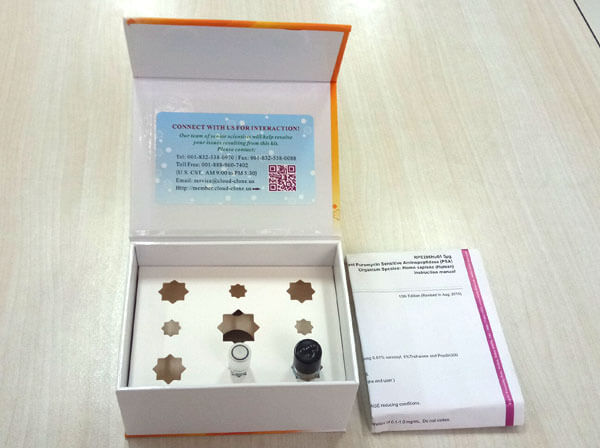 Packages (Simulation)
-
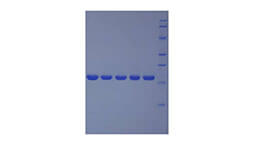
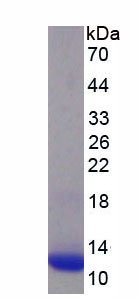 Figure. SDS-PAGE
-
 ISO9001: 2008, ISO13485: 2003 Registered
Activity test
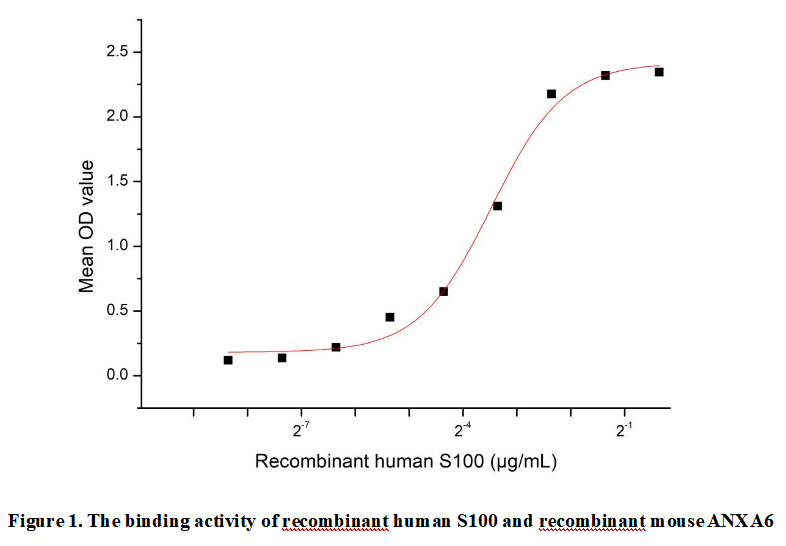
S100 Calcium Binding Protein (S100) is a member of the S100 calcium-binding protein family, primarily expressed in cardiac and skeletal muscle cells. This 10.4 kDa protein plays crucial roles in calcium homeostasis, muscle contraction regulation, and energy metabolism through interactions with target proteins like titin and ryanodine receptors. S100A1's dysregulation is associated with cardiovascular diseases, including heart failure and hypertrophy. S100 directly binds ANXA6 in a calcium-dependent manner, modulating membrane repair processes.Thus a functional binding ELISA assay was conducted to detect the interaction of recombinant human S100 and recombinant mouse ANXA6 .Briefly, biotin-linked S100 were diluted serially in PBS, with 0.01% BSA (pH 7.4). Duplicate samples of 100μl were then transferred to ANXA6-coated microtiter wells and incubated for 1h at 37℃. Wells were washed with PBST 3 times and incubation with Streptavidin-HRP for 30min, then wells were aspirated and washed 5 times. With the addition of substrate solution, wells were incubated 15-25 minutes at 37℃. Finally, add 50µl stop solution to the wells and read at 450nm immediately. The binding activity of recombinant human S100 and recombinant mouse ANXA6 was shown in Figure 1, the EC50 for this effect is 0.09 µg/mL.
Usage
Reconstitute in 10mM PBS (pH7.4) to a concentration of 0.1-1.0 mg/mL. Do not vortex.
Storage
Avoid repeated freeze/thaw cycles. Store at 2-8°C for one month. Aliquot and store at -80°C for 12 months.
Stability
The thermal stability is described by the loss rate. The loss rate was determined by accelerated thermal degradation test, that is, incubate the protein at 37°C for 48h, and no obvious degradation and precipitation were observed. The loss rate is less than 5% within the expiration date under appropriate storage condition.
Increment services
-
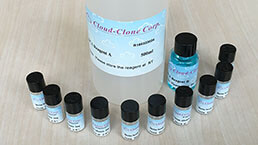 BCA Protein Quantification Kit
-
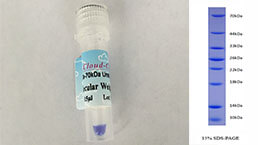 Molecular Mass Marker for Protein
-
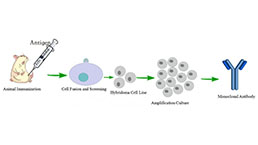 Monoclonal Antibody Customized Service
-
 Polyclonal Antibody Customized Service
-
 Protein Activity Test Experiment Service
-
 Electrophoretic Mobility Shift Assay (EMSA) Experiment Service
-
 Buffer
-
 Lentivirus Packaging Experiment Service
-
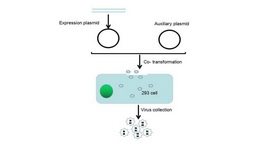 Adenovirus Packaging Experiment Service
-
 Real Time PCR Experimental Service
-
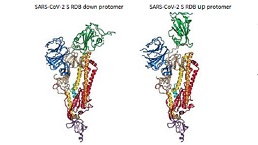 Spike RBD Protein (S-RBD)
-
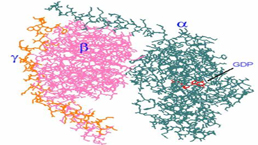 Protein G
-
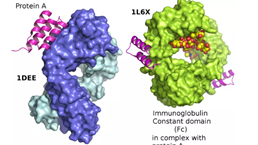 Protein A
Citations
- Vasoactive intestinal peptide protects against ischemic brain damage induced by focal cerebral ischemia in ratsScienceDirect: S0006899311008663
- A New Technique for Collection of Cerebrospinal Fluid in Rat PupsPubMed: 26056488
- Regulation of Nutritional Metabolism in Transition Dairy Cows: Energy Homeostasis and Health in Response to Post-Ruminal Choline and Methioninepubmed:27501393
- Ellagic acid exerts protective effect in intrastriatal 6-hydroxydopamine rat model of Parkinson's disease: Possible involvement of ERβ/Nrf2/HO-1 signaling.pubmed:28238669
- Levels of neurotropic autoantibodies in patients with schizophreniaarticle:n
- Epigallocatechin-3-Gallate Reduces Neuronal Apoptosis in Rats after Middle Cerebral Artery Occlusion Injury via PI3K/AKT/eNOS Signaling PathwayPubmed:29770336
- Trigonelline protects hippocampus against intracerebral Aβ (1–40) as a model of Alzheimer's disease in the rat: insights into underlying mechanismsPubmed: 30421246
- ВОЗМОЖНОСТЬ ПРОГНОЗИРОВАНИЯ ОСТРОЙ НЕСПЕЦИФИЧЕСКОЙ БОЛИ В НИЖНЕЙ ЧАСТИ СПИНЫ С ИСПОЛЬЗОВАНИЕМ СЫВОРОТОЧНЫХ …
- ВЛИЯНИЕ ХРОНИЧЕСКОГО ВВЕДЕНИЯ НЕЙРОЛЕПТИКОВ НА УРОВНИ НЕЙРОСПЕЦИФИЧЕСКИХ АУТОАНТИТЕЛ В КРОВИ У КРЫС