


Cloud-Clone CPP ELISA Kit supports osteoarthritis research published in Science
On October 1, 2026, the research team led by Professor Je-Hwang Ryu from the College of Dentistry, Chonnam National University, South Korea, published an article entitled “Hypertension fuels osteoarthritis through neuroendocrine signaling” in Science. The study verified that hypertension accelerates osteoarthritis progression via the AVP-AVPR1A neuroendocrine signaling axis, revealing the molecular mechanism linking hypertension to impaired cartilage homeostasis. Meanwhile, it suggests AVPR1A and its downstream mediators may serve as potential therapeutic targets to slow osteoarthritis progression in hypertensive patients with joint injury.

This study integrates a population cohort, two hypertensive mouse models, human joint samples, and multi-omics to reveal that the neuroendocrine AVP–AVPR1A signaling axis is the molecular link through which hypertension accelerates the progression of osteoarthritis (OA). Epidemiological evidence confirms that hypertension is independently associated with OA prevalence, with a stronger association observed in cases with more severe structural joint damage. Hypertension elevates circulating arginine vasopressin (AVP); mechanical injury or aging upregulates the AVP receptor AVPR1A in chondrocytes, enabling them to respond to circulating AVP, thereby constituting a "double-hit" model. AVP–AVPR1A activates the downstream transcription factor NR4A3, upregulates the matrix-degrading enzymes MMP3/MMP13, suppresses cartilage anabolism, and promotes cartilage destruction and subchondral bone plate thickening; this pathway is independent of the RAAS system, oxytocin receptor, and chondrocyte senescence. Knockout of Avpr1a or intra-articular local administration of the AVPR1A antagonist Relcovaptan significantly alleviates hypertension-driven OA damage. This study suggests that AVPR1A and its downstream molecules may serve as potential therapeutic targets for hypertension comorbid with osteoarthritis.
Serum copeptin (a stable surrogate marker of AVP) levels in mice were detected using Cloud-Clone’s Copeptin (CPP) ELISA kit: serum copeptin was significantly higher in DOCA-salt hypertensive mice (n=10 per group) than in controls (P=0.0081); no statistically significant difference in serum copeptin was observed between mice receiving intra-articular injection of Ad-C and Ad-A (n=8 per group, P=0.5183). These results suggest that DOCA-salt-induced hypertension elevates circulating AVP levels, while local intra-articular genetic manipulation does not affect systemic copeptin concentration.
Products Name: CEA365Mu
Products Name: ELISA Kit for Copeptin (CPP)
Sample type:mouse serum
Application type:ELISA
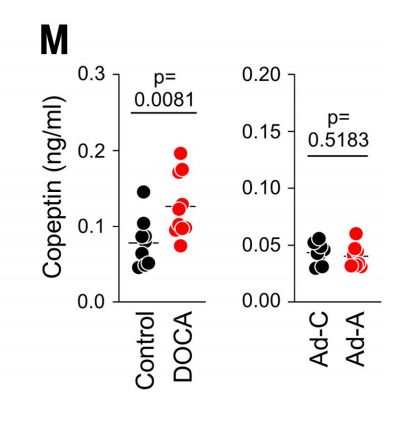
Fig. 3. The AVP-AVPR1A axis is required for hypertension-induced acceleration of OA. (M) Serum copeptin levels in DOCA-salt (n = 10 mice per group) and IA injection