


Polyclonal Antibody to Creatine Kinase MB Isoenzyme (CKMB) 

CK2; CK-MB; Creatine Kinase,Muscle/Brain
- UOM
- FOB US$ 135.00 US$ 315.00 US$ 450.00 US$ 1,125.00 US$ 4,500.00
- Quantity
Overview
Properties
- Product No.PAA479Mu01
- Organism SpeciesMus musculus (Mouse) Same name, Different species.
- ApplicationsWB,IHC
If the antibody is used in flow cytometry, please check FCM antibodies.
Research use only - Downloadn/a
- CategoryEnzyme & KinaseCardiovascular biology
- SourcePolyclonal antibody preparation, Host Rabbit
- Ig Type IgG, Potency n/a
- PurificationAntigen-specific affinity chromatography followed by Protein A affinity chromatography
- LabelNone
- Immunogen RPA479Mu01-Recombinant Creatine Kinase MB Isoenzyme (CKMB)
- Buffer Formulation0.01M PBS, pH7.4, containing 0.05% Proclin-300, 50% glycerol.
- TraitsLiquid, Concentration 0.5mg/mL
Sign into your account
Share a new citation as an author
Upload your experimental result
Review

Contact us
Please fill in the blank.
-
 Packages (Simulation)
-
 Packages (Simulation)
-
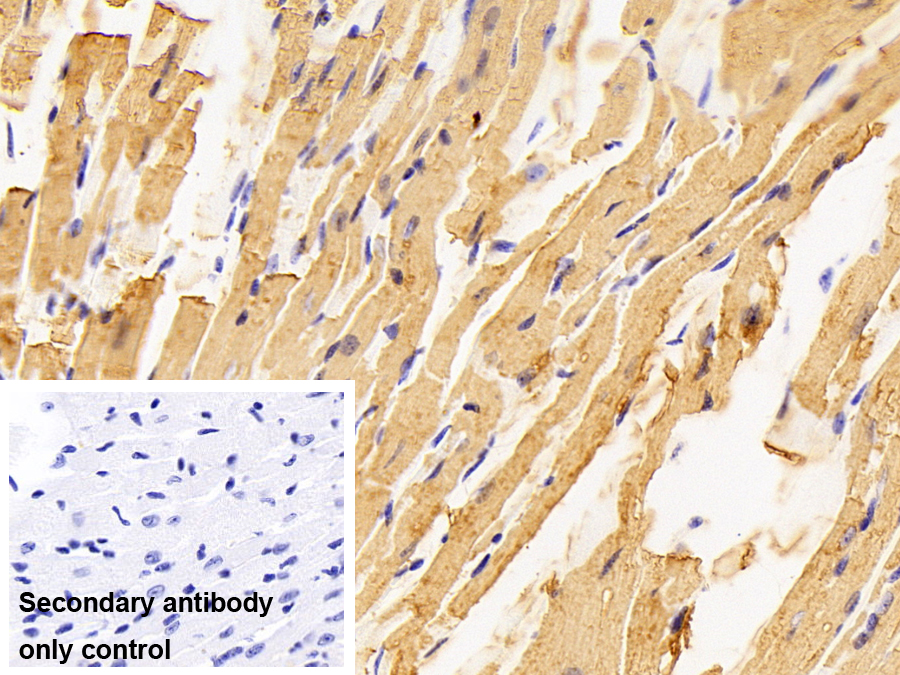 DAB staining on IHC-P;
Sample: Mouse Cardiac Muscle Tissue
Primary Ab: 10µg/ml Rabbit Anti-Mouse CKMB Antibody
Control: Used PBS instead of primary antibody
Second Ab: 2µg/ml HRP-Linked Caprine Anti-Rabbit IgG Polyclonal Antibody
(Catalog: SAA544Rb19)
-
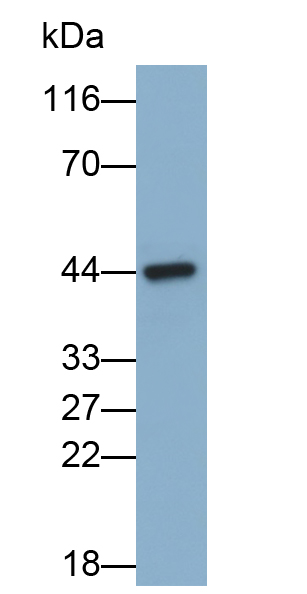 Western Blot; Sample: Mouse Cerebrum lysate
Primary Ab: 0.1µg/ml Rabbit Anti-Mouse CKMB Antibody
Second Ab: 0.2µg/ml HRP-Linked Caprine Anti-Rabbit IgG Polyclonal Antibody
(Catalog: SAA544Rb19)
-
 ISO9001: 2008, ISO13485: 2003 Registered
Specifity
The antibody is a rabbit polyclonal antibody raised against CKMB. It has been selected for its ability to recognize CKMB in immunohistochemical staining and western blotting.
Usage
Western blotting: 0.01-2µg/mL;
Immunohistochemistry: 5-20µg/mL;
Optimal working dilutions must be determined by end user.
Storage
Store at 4°C for frequent use. Stored at -20°C in a manual defrost freezer for two year without detectable loss of activity. Avoid repeated freeze-thaw cycles.
Stability
The thermal stability is described by the loss rate. The loss rate was determined by accelerated thermal degradation test, that is, incubate the protein at 37°C for 48h, and no obvious degradation and precipitation were observed. The loss rate is less than 5% within the expiration date under appropriate storage condition.
Giveaways
Increment services
Citations
- Aldehyde Dehydrogenase-2 Activation during Cardioplegic Arrest Enhances the Cardioprotection against Myocardial Ischemia–Reperfusion InjuryPubMed: 22814936
- N-Acetylcysteine and Allopurinol Confer Synergy in Attenuating Myocardial Ischemia Injury via Restoring HIF-1α/HO-1 Signaling in Diabetic RatsPubMed: PMC3715528
- Effects of morphine and sufentanil preconditioning against myocardial ischemic-reperfusion injury in rabbitsPubMed: 26629064
- Diabetes blocks the cardioprotective effects of sevoflurane postconditioning by impairing Nrf2/Brg1/HO-1 signalingPubmed:26973173
- Effect of levocarnitine on TIMP-1, ICAM-1 expression of rats with coronary heart disease and its myocardial protection effectPubmed:26972400
- Circulating miR-126 and miR-499 reflect progression of cardiovascular disease; correlations with uric acid and ejection fractionpubmed:27924211
- Peroxisome proliferator-activated receptor γ (PPARγ) mediates the protective effect of quercetin against myocardial ischemia-reperfusion injury via …PMC5209473
- In Vivo Cardioprotective Effects and Pharmacokinetic Profile of N-Propyl Caffeamide AgainstIschemia Reperfusion Injury.pubmed:27480649
- Cardiac biomarkers in dogs with visceral leishmaniasisS0301-732X2016000300004
- Remote Limb Ischaemic Postconditioning Protects Against Myocardial Ischaemia/ Reperfusion Injury in Mice: Activation of JAK/STAT3-Mediated Nrf2-Antioxidant Signalling10.1159:481755
- Morinda Citrifolia (Noni) and Low Dose Aspirin Prevent Apoptotic Cell Death and Oxidative Stress on Isoproterenol Induced Myocardial Infarction in RatsDOI: 10.5152/etd.2017.1732
- Metformin attenuated endotoxin-induced acute myocarditis via activating AMPKpubmed:28410530
- Co-exposure of silica nanoparticles and methylmercury induced cardiac toxicity andPubmed:29727991
- GYY4137 protects against myocardial ischemia/reperfusion injury via activation of the PHLPP-1/Akt/Nrf2 signaling pathway in diabetic micePubmed:29605032
- Hydrogen‑rich solution against myocardial injury and aquaporin expression via the PI3K/Akt signaling pathway during cardiopulmonary bypass in ratsPubmed:29956781
- Cyclic helix B peptide ameliorates acute myocardial infarction in mice by inhibiting apoptosis and inflammatory responses
- Adiponectin Facilitates Postconditioning Cardioprotection through Both AMPK-Dependent Nuclear and AMPK-Independent Mitochondrial STAT3 ActivationPubmed: 32190173
- Tissue suction-mediated gene transfer to the beating heart in micePubmed: 32027678
- Deletion of Rap1 protects against myocardial ischemia/reperfusion injury through suppressing cell apoptosis via activation of STAT3 signalingPubmed: 32020680
- Differentially expressed lncRNAs, miRNAs and mRNAs with associated ceRNA networks in a mouse model of myocardial ischemia/reperfusion injuryPubmed: 32705277
- Hydrogen sulphide and nitric oxide cooperate in cardioprotection against ischemia/reperfusion injury in isolated rat heartPubmed: 32871779
- Melatonin Attenuates Anoxia/Reoxygenation Injury by Inhibiting Excessive Mitophagy Through the MT2/SIRT3/FoxO3a Signaling Pathway in H9c2 CellsPubmed: 32546969
- Biological Safety and Biodistribution of Chitosan NanoparticlesPubmed: 32340313
- The mRNA expression of Il6 and Pdcd1 are predictive and protective factors for doxorubicin?induced cardiotoxicity33300057
- Inactivation of TOPK Caused by Hyperglycemia Blocks Diabetic Heart Sensitivity to Sevoflurane Postconditioning by Impairing the PTEN/PI3K/Akt Signaling33986917
- Long non-coding RNA MALAT1 modulates myocardial ischemia-reperfusion injury though the PI3K/Akt/eNOS pathway by sponging miRNA-133a-3p to target IGF1R …Pubmed:34968461
- Hyperglycemia-Induced Overexpression of PH Domain Leucine-Rich Repeat Protein Phosphatase 1 (PHLPP1) Compromises the Cardioprotective Effect of Ischemic …Pubmed:35715527
- Mokko Lactone Alleviates Doxorubicin-Induced Cardiotoxicity in Rats via Antioxidant, Anti-Inflammatory, and Antiapoptotic Activities. Nutrients 2022, 14, 733Pubmed:35215383
- Hydrogen therapy after resuscitation improves myocardial injury involving inhibition of autophagy in an asphyxial rat model of cardiac arrestPubmed:35495584
- MicroRNA-503 Exacerbates Myocardial Ischemia/Reperfusion Injury via Inhibiting PI3K/Akt-and STAT3-Dependent Prosurvival Signaling PathwaysPubmed:35620576
- Vitamin E Attenuates Cardiomyopathy Via Alleviation of Autophagic Stress